

Vietnam’s Electric Scooter Adoption accelerates in the last twelve months and the country is emerging as one of the world’s most strategically important electric two-wheeler markets for the next decade.
Urban Mobility Under Pressure
Vietnam is undertaking one of the most ambitious urban infrastructure transformation programs in Southeast Asia, with public investment exceeding 5.7% of GDP. Major projects in Hanoi and Ho Chi Minh City (HCMC) aim to improve connectivity, reduce congestion, and support long-term economic growth.
Yet infrastructure expansion alone is struggling to keep pace with the scale of urban mobility demand.
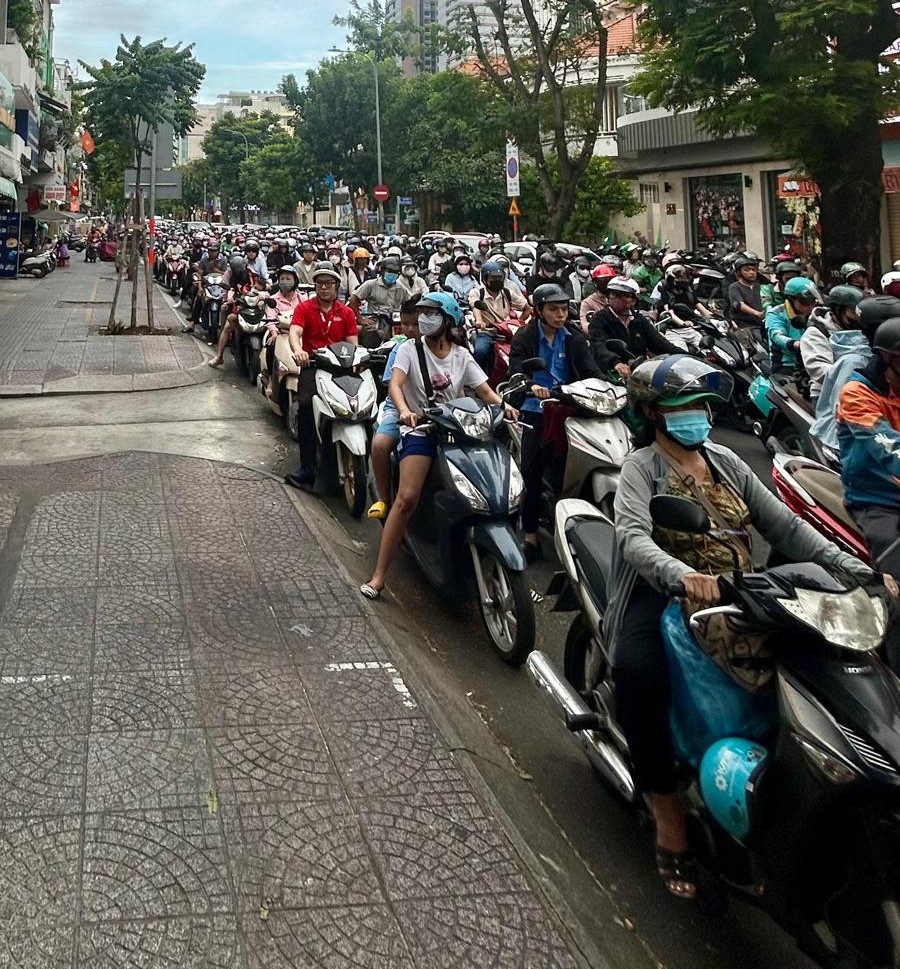
Vietnam has an estimated 77 million registered motorcycles for a population of approximately 101 million people, making it one of the most motorcycle-dependent countries in the world. With only around 42% of the population living in urban areas, the concentration of motorcycles in major cities is exceptionally high.
The result is severe congestion and deteriorating air quality across the country’s largest metropolitan areas.
Ho Chi Minh City alone is estimated to host between 8 and 9 million motorcycles, creating one of the densest two-wheeler environments globally. Nationwide, approximately 86% of households own at least one motorcycle, while two-wheelers account for 85–90% of total road traffic and roughly 96% of passenger vehicles.
The challenge is particularly acute in Vietnam’s largest urban centers. Ho Chi Minh City’s metropolitan area exceeds 14 million inhabitants, while Hanoi is home to approximately 8.8 million people, with five additional metropolitan areas surpassing one million residents.

Electric Two-Wheeler Development
Unlike many regional markets, Vietnam has historically focused its EV policies on the supply side rather than direct consumer incentives.
Government support has primarily targeted manufacturers willing to invest in local production capacity, helping establish Vietnam as one of the most important electric two-wheeler manufacturing hubs in Asia. This strategy attracted international players such as Yadea, while domestic champion VinFast has rapidly emerged as one of the world’s largest electric two-wheeler manufacturers.
The market was already experiencing robust growth before a major policy shift occurred in July 2025.
Hanoi’s Low-Emission Strategy
On July 12, 2025, Prime Minister Pham Minh Chinh issued Directive No. 20, establishing an ambitious roadmap to reduce fossil-fuel vehicle usage in Hanoi.
The original plan called for a complete ban on internal combustion engine (ICE) motorcycles within Ring Road 1 by mid-2026, followed by a gradual expansion of restrictions to Ring Road 2 from January 2028 and eventually Ring Road 3.
To support the transition, local authorities developed subsidy programs designed to help residents replace older gasoline-powered motorcycles with electric alternatives.
However, implementation challenges quickly became evident.
Faced with concerns over feasibility, infrastructure readiness, and potential social disruption, Hanoi authorities subsequently revised the strategy. Rather than introducing an immediate blanket ban, the city adopted a phased approach centered on the gradual deployment of Low Emission Zones (LEZs).
Beginning on July 1, 2026, Hanoi will launch pilot LEZ programs within selected areas of Ring Road 1. Restrictions will apply progressively to specific vehicle categories and geographic zones, allowing authorities to evaluate operational impacts before broader implementation.
This adjustment reflects a more pragmatic approach that balances environmental objectives with economic realities and public acceptance.
Ho Chi Minh City Follows a Similar Path
Ho Chi Minh City has adopted a comparable strategy.
The municipal government has begun implementing a phased traffic restriction plan aimed at reducing emissions in the most congested districts. Initial measures focus on commercial and delivery motorcycles powered by fossil fuels, while selected central areas are being designated as future low-emission zones.
Although less aggressive than initially proposed in Hanoi, the policy signals a clear direction of travel: urban authorities increasingly view electrification as a critical tool for addressing congestion, air pollution, and sustainability objectives.
Strategic Implications
Vietnam’s electric two-wheeler market is entering a new phase.
Until recently, growth was driven primarily by industrial policy, local manufacturing investment, and increasing consumer awareness. The introduction of urban emission-control measures now adds a powerful demand-side catalyst.
While the transition is likely to proceed more gradually than originally envisioned, the strategic direction is increasingly clear. Major cities are moving toward tighter restrictions on fossil-fuel vehicles, creating a favorable environment for electric two-wheelers over the medium term.
For manufacturers, the opportunity is significant. Vietnam combines one of the world’s largest motorcycle fleets with growing environmental pressures, strong domestic manufacturing capabilities, and increasingly supportive urban mobility policies.
Key Takeaway
Vietnam’s electric two-wheeler transition is shifting from an industrial development story to an urban mobility necessity. While authorities have softened the timeline for restricting ICE motorcycles, Hanoi and Ho Chi Minh City have established a clear policy trajectory that is expected to accelerate EV adoption over the coming decade, positioning Vietnam among the most important electric two-wheeler markets globally.