

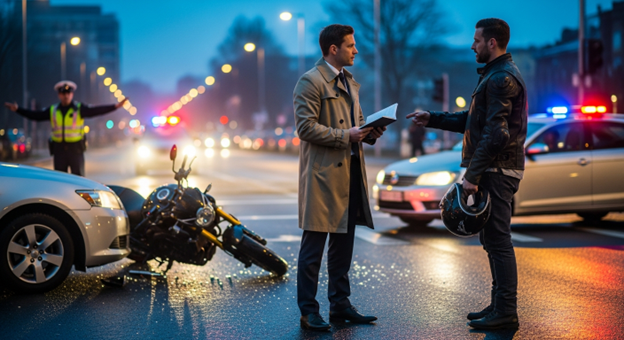
A car turning left into a motorcycle is one of the most violent types of collisions on the road. The driver misjudges the bike’s speed, cuts across the lane, and the rider takes the full force of impact with zero structural protection.
There’s no crumple zone. No enclosed cabin. The kinetic energy transfers directly to the rider’s body, often causing immediate ejection and catastrophic trauma. It’s a scenario every motorcyclist dreads, and the data shows it keeps happening at an alarming rate.
Legally, the turning driver is usually liable for failing to yield. However, insurance adjusters closely review the rider’s approach speed, lane position, and visibility. If the rider is partly at fault, compensation can decrease quickly under state law.
Why Left-Turn Intersections Are So Dangerous for Riders
The “Left-Turn Gap” Error
Intersections are the most dangerous environments for motorcyclists, and left-hand turns are the main reason. About 53% of crossing-path crashes involve left turns. Right turns? Just under 6%.
So what’s going wrong? It comes down to how human vision processes information on busy, multi-lane roads. California Highway Patrol data shows that drivers consistently misjudge how fast a motorcycle is approaching and how far away it actually is. In dense urban areas like South Florida, older drivers and heavy traffic volumes make the problem even worse.
There’s a technology angle here, too. Electric motorcycles with near-instant torque and rapid acceleration are making it harder for drivers to visually track closing speeds. That shifting threat is already influencing global sales trends, pushing consumer demand toward bikes with better anti-lock braking systems (ABS) and improved visibility features.
How Liability Gets Sorted After a Left-Turn Crash
Right-of-Way Rules and Shared Fault
Traffic law requires a left-turning driver to yield to oncoming vehicles. Failing to yield forms a strong negligence case. But adjusters may argue the rider was speeding, mispositioned, or failed to evade. Understanding your state’s fault rules is essential.
For instance, if you were hit on a motorcycle in a left-hand turn collision in Florida, the state uses modified comparative fault rules. Your compensation gets reduced by whatever percentage of blame is assigned to you. And if your share of fault crosses a certain statutory threshold, you could lose the right to recover anything at all.
Here’s how liability typically breaks down between the turning driver and the motorcyclist:
| Liability Factor | Turning Driver Liability | Motorcyclist Comparative Fault Risks |
| Right-of-way | Turning across an active lane without a protected green arrow | Riding in an illegal or non-designated lane |
| Speed and distance | Misjudging the gap and violating the motorcycle’s space | Traveling significantly over the posted speed limit |
| Visibility | Distracted driving or failing to check blind spots | Operating without mandatory headlights or reflective gear |
| Evasive action | Failing to brake mid-turn after spotting the oncoming hazard | Insufficient following distance or improper braking technique |
What Evidence Do You Need After a Left-Turn Crash?
Documenting the Scene
Good documentation at the crash scene can make or break your legal and financial claims. Don’t rely on the at-fault driver’s version of events. That’s a recipe for disaster, especially given how chaotic these impacts tend to be.
Recent incidents underscore the severity of these collisions. A fatal crash on I-11 and a Canadian collision where a GSX-R750 ended up on a pole after a BMW driver failed to yield both illustrate what riders are up against. Getting an official third-party record from law enforcement isn’t optional; it’s your foundation.
Here are the steps you should prioritize at the scene:
- Call law enforcement immediately. An official police report documents the position of the turning vehicle, the intersection conditions, and a preliminary fault assessment.
- Preserve physical evidence. Photograph skid marks, the point of impact, and vehicle resting positions before anything gets moved.
- Get independent witness info. Bystander testimony becomes critical when the driver disputes your speed or visibility.
- See a doctor right away. Internal injuries from frontal impacts don’t always show symptoms immediately. An ER visit creates the medical timeline you’ll need later.
Reducing Your Left-Turn Risk
The left-turn gap error remains a top threat to rider safety, driving fatality rates far above those for other crash types. But riders can take action. Learn how comparative negligence works locally and document every crash to protect your health and finances.
Technology continues to advance. Improved left-turn signals, smarter traffic lights, and V2X communications can help drivers detect oncoming hazards sooner. ARAS systems add emergency braking and visual alerts to new motorcycles. These solutions don’t remove the danger, but they are an important progress.