


Piaggio is struggling to defend its position as Vespa’s brand strength is no longer enough to offset weak innovation and rising competition. Global sales fell to 265,621 units in 2025 (-13.6%), the lowest level in a decade.
McD tracks new vehicles registrations across the World (97+ countries), reporting data on calendar year. When you wish to compare data reported by us to those declared by the manufacturers, consider they usually report their “sales” (vehicles invoiced), which are usually different from “registrations”, accordingly with their fiscal year split. In case of Piaggio, we do not track Porter sales.
Piaggio Global Performance
Piaggio, the iconic Italian manufacturer and creator of the Vespa, has managed for years to defend its global volumes against the rapid expansion of low-cost Chinese and Indian competitors, leveraging its unmatched brand heritage and premium positioning.
However, defense is rarely a winning strategy in a fast-evolving industry. In recent years, Piaggio has underinvested in innovation and R&D, prioritizing branding, marketing, and distribution over product renewal—an approach that is now showing clear limits.
The strength of the Vespa brand has long acted as a buffer, supporting growth between 2019 and 2022, particularly in high-potential markets such as Indonesia, Thailand, and China. Yet, early signs of weakness were already visible in core European and Asian markets, including France, the Netherlands, and Vietnam.
Following this temporary momentum, global sales declined in 2023 and 2024, returning roughly to 2019 levels.
The real inflection point came in 2025, when volumes dropped sharply by 13.6% to 265,621 units, marking the lowest level in the past decade.
More concerning is the structural erosion in key markets:
- France: -71% vs 2019, -35.0% in 2025
- Netherlands: -37.6% in 2025
- Spain: -40.4%
- UK: -25%
- Vietnam: -22%
Piaggio is now clearly under attack across its historical strongholds, while competitors are gaining ground with more competitive pricing, faster product cycles, and stronger EV positioning.
The Vespa Heritage
Piaggio is an Italian motor vehicle manufacturer, which produces a range of two-wheeled motor vehicles and compact commercial vehicles.
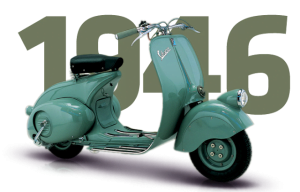
Founded in the 1884 by Rinaldo Piaggio, the company started producing two-wheeler immediately after the II World War, launching in April 1946 the Vespa (Italian for “wasp”) a vehicles deputy to change the human mobility and become an icon for style and efficiency.
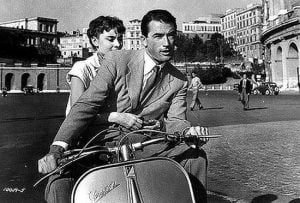
The global Vespa success arrived when in 1952, Audrey Hepburn side-saddled Gregory Peck’s Vespa in the feature film Roman Holiday for a ride through Rome.
In 1956, John Wayne dismounted his horse in favor of the two-wheeler to originally get between takes on sets as well as Marlon Brando, Dean Martin, and the entertainer Abbe Lane had become Vespa owners. William Wyler filmed Ben Hur in Rome in 1959, allowing Charlton Heston to abandon horse and chariot between takes to take a spin on the Vespa.
In 1956, with production of the millionth Vespa scooter, Italy had its first mass-produced motorised vehicle. Taking advantage of increased cash flow thanks to the success of the Vespa, Piaggio developed other products, including the 1957 Vespa 400, a compact passenger car and in 1959 Piaggio was acquired by the Agnelli family, the owners of car maker Fiat SpA, further developing the global presence and the production. In the 1960 over 4 million Vespa had been produced worldwide!
Since 2003, Piaggio Group is controlled by IMMSI, a holding company of the Colaninno family.
Actually the Piaggio & C Spa controls seven brands: Piaggio, Vespa, Gilera, Aprilia, Moto Guzzi, Derbi and Vespa, after that the owner decided to sell the current Vespa version under its own name and – in some countries -with a dedicated distribution network.