


Global ATV/SSV sales fell to 0.8 million units (-1.6%) in 2025, marking five consecutive years below the 2020 peak as North America—still ~50% of volume—continues to contract and weigh on the industry. Traditional Makers face structural pressure from rapidly advancing Chinese manufacturers.
ATV & RUV Global Market Trend – Structural Shift Underway
The global ATV and SSV/RUV industry is undergoing a structural realignment that is increasingly challenging the historical dominance of North American and Japanese incumbents. For decades, the market was shaped by a handful of established brands controlling distribution, pricing power, and product innovation. That advantage is now eroding.
Chinese manufacturers are no longer competing solely on low pricing. They are scaling rapidly, expanding global distribution networks, and closing the technology and quality gap at an accelerated pace. In several emerging markets, they are becoming the default choice—not just the budget alternative. Meanwhile, traditional leaders appear slow to adjust cost structures, reposition product portfolios, or rethink their exposure to mature markets.
Market Performance: Stagnation After the Peak
After a decade of growth culminating in the 2020 peak of 0.9 million units, global sales have steadily softened. In 2025, the market declined another 1.6% to approximately 0.8 million units—marking five years of structural stagnation rather than cyclical weakness.
While part of the correction reflects post-pandemic normalization, the prolonged contraction suggests deeper issues: saturation in core North American markets, pricing pressure, and intensifying competition from lower-cost producers.
(Data coverage excludes parts of the Middle East and Africa, meaning total global volume is slightly understated.)
Regional Dynamics: North America No Longer the Growth Engine
North America remains the largest market, accounting for roughly half of global sales. However, sales fell 2.7% in 2025 and the region has been responsible for most of the industry’s five-year decline.
This is a critical vulnerability. Incumbent OEMs remain heavily dependent on a mature, cyclical, and increasingly price-sensitive domestic market. High product prices, rising financing costs, and limited product democratization have constrained volume growth. Meanwhile, Chinese competitors are expanding aggressively in Latin America, parts of Asia, and Eastern Europe—regions where North American brands historically underinvested.
Asia declined 7.6% in 2025, reflecting demand normalization and competitive reshuffling, while Western Europe posted a modest +1.1%, signaling stabilization but not acceleration.
The standout performer is Latin America, where volumes have quadrupled in five years and surged 53.1% in 2025 alone. This region is rapidly becoming the strategic battleground—and Chinese brands are moving faster and more decisively than traditional Western players.
Strategic Weakness of North American Incumbents
The main risk for North American leaders is structural complacency:
-
Heavy dependence on high-margin domestic customers
-
Limited cost competitiveness versus Chinese OEMs
-
Slower adaptation to entry-level and mid-range segments
-
Exposure to interest-rate sensitivity and consumer financing cycles
If incumbents continue defending margin rather than defending market share, they risk gradual erosion in global positioning—particularly in emerging regions where long-term growth remains strongest.
2026 Outlook: Divergence and Strategic Inflection Point
The 2026 outlook suggests moderate global stabilization, but with significant regional divergence.
Base Scenario (Most Likely)
Global sales stabilize or post low single-digit growth (0–3%), driven by:
-
Continued expansion in Latin America
-
Gradual recovery in parts of Europe
-
Competitive gains by Chinese manufacturers
North America remains flat or slightly negative, with demand constrained by financing costs and market saturation.
Upside Scenario
If interest rates ease significantly and consumer confidence improves in the U.S., pent-up demand could support a cyclical rebound. However, such recovery would likely benefit price-aggressive brands the most.
Downside Risk Scenario
Key risks for 2026 include:
-
Escalating trade tensions and tariffs impacting supply chains
-
Further slowdown in U.S. consumer spending
-
Currency volatility in emerging markets
-
Geopolitical conflicts increasing regulatory scrutiny on off-road vehicle usage
Additionally, the controversial military use of utility vehicles could trigger tighter export controls or reputational risks for manufacturers.
Strategic Conclusion
The global ATV and RUV market is no longer defined by volume growth but by competitive restructuring. The industry is moving from a North America–centric profit model toward a multipolar and cost-competitive landscape.
2026 may not be the year of recovery—it may be the year that determines which players adapt and which continue to lose ground.

Industry Characteristics
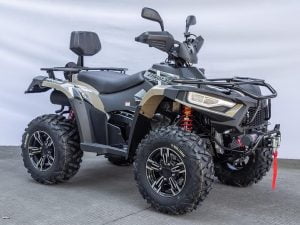
An all-terrain vehicle (ATV), also known as a light utility vehicle (LUV), quad bike, or simply a quad, as defined by the American National Standards Institute (ANSI); is a vehicle that travels on low-pressure tires, with a seat that is straddled by the operator, along with handlebars for steering control. As the name implies, it is designed to handle a wider variety of terrain than most other vehicles.
The rider sits on and operates these vehicles like a motorcycle, but the extra wheels give more stability at slower speeds. Although most are equipped with three or four wheels, six-wheel models exist for specialized applications. Multiple-user analogues with side-by-side seating are called RUV (Recreational utility Vehicle) or utility terrain vehicles (UTVs) or side-by-sides to distinguish the classes of vehicle.
Although it is a street-legal vehicle in several countries, it is not street-legal within most states, territories, and provinces of Australia, the United States or Canada. In countries/States were these vehicles are not street-legal, they do not need to be registered and do not need a plate.


Utility task vehicles (UTV) also termed as recreational off highway vehicle (ROV) is an automobile primarily used for commercial, transportation and recreational purposes, while All-terrain vehicle (ATV) is automotive equipment designed to handle terrain than most other vehicles.
Expertly haul your ATVs with a Bear Track Trailer. For outdoor enthusiasts and adventure seekers, Bear Track Trailers are known for their robust and lightweight aluminum trailers, offering a practical solution for transporting ATVs and UTVs to any off-road destination. Be sure to check out K&K’s UTVs for sale if you’re in the market.