

As electric motorcycles move into the mainstream, motor selection has become one of the most decisive factors shaping overall performance. Whether for a custom build or a commercial platform, the choice of a high-torque BLDC motor determines real-world acceleration, hill-climbing capability, and energy efficiency. Modern brands—from NIU’s urban scooters to Sur-Ron’s off-road machines and Zero’s high-performance mid-drive models—illustrate how the industry is shifting away from one-size-fits-all designs toward specialized BLDC architectures tailored to different riding styles and performance tiers.
Selecting the right motor begins with defining the performance you expect: top speed, acceleration, vehicle weight, terrain, voltage system, and thermal demands. This guide integrates engineering principles with practical riding considerations to help you choose a motor that balances torque, efficiency, durability, and overall ride quality.
Defining Performance Requirements
Before choosing a BLDC motor, it helps to clearly understand what you expect from your electric motorcycle. Different riding styles and terrains place different demands on the motor.
• What level of performance do you want?
- Your target top speed
- How quickly you want to accelerate
- The combined weight of the bike and rider
- Whether you ride mostly on flat city streets or need the strength to climb hills
A lightweight commuter scooter may only need moderate torque for smooth acceleration in traffic, while an off-road motorcycle requires strong low-speed pulling power for steep climbs and uneven terrain. Performance mid-drive motorcycles such as those from Zero Motorcycles need significantly higher continuous torque and strong thermal management to maintain power at higher speeds—very different from daily-use scooters from NIU or Gogoro.
• Why torque matters to your riding experience
Torque affects how confidently a motorcycle starts from a stop, carries weight, and climbs slopes. Higher torque means the bike feels more responsive and powerful, especially at low speeds.
Engineering formulas such as torque = force × wheel radius provide an estimate, but what matters to riders is ensuring the motor can handle real-world demands without overheating or losing power during prolonged use.
• How you plan to ride affects the motor you need
- Long highway rides require motors that can sustain power continuously without overheating.
- City riding needs smooth, predictable low-speed control for frequent stops and starts.
• Voltage affects power and efficiency
Choosing between 48 V, 60 V, 72 V or higher systems influences both performance and efficiency. Higher voltage means stronger acceleration and lower current draw, which helps improve battery life and motor temperature—something riders will feel in both responsiveness and range.
How Motor Characteristics Define Electric Motorcycle Performance
Several core BLDC motor characteristics have a direct impact on how an electric motorcycle feels on the road. Understanding these helps riders choose a motor that fits their expectations for acceleration, hill-climbing, and overall responsiveness.
1. Torque Delivery Across Speed Range
The torque-speed curve determines how strongly the bike can pull at different speeds. Motors with higher low-speed torque provide quicker launches and more confident hill climbing, which is especially valuable for off-road or heavy commuter motorcycles. Models focused on higher top speeds prioritize torque stability at mid- and high-RPM.
2. KV Rating and Motor Torque Characteristics
KV indicates how fast the motor spins per volt, and it influences the balance between acceleration and top speed. Lower-KV motors generally offer better torque and stronger low-speed performance, while higher-KV designs support higher maximum speed. For riders who value rapid takeoff or steep-slope capability, a lower-KV, higher-torque motor is usually the better match.
3. Motor Architecture: Hub vs. Mid-Drive
Hub motors, commonly used in scooters like NIU or Gogoro, deliver smooth low-speed torque and simple maintenance, making them ideal for urban riding. Mid-drive motors—used in performance-oriented models such as Sur-Ron and Zero—benefit from gearing, better cooling, and a wider usable RPM range, giving them superior performance for sport and off-road applications.
This contrast forms a clear trend: hub motors suit simple city riding, while mid-drives have become the mainstream choice for high-performance and off-road electric motorcycles.
4. Control System, Cooling, and Durability
Sensored motors provide smoother starts and more precise low-speed control, improving ride quality in traffic or on inclines. Effective cooling—whether through airflow, heat sinks, or liquid systems—ensures the motor maintains power during long climbs and high-speed riding. Weather sealing, bearing quality, and IP protection contribute to long-term reliability in varied conditions.
The Core Trade-Offs
Selecting a high-torque BLDC motor for an electric motorcycle is not simply a matter of choosing a component; it is a decision that ultimately defines how the motorcycle rides, accelerates, and performs across varied conditions.
1. Torque vs. Top Speed: Understanding the Acceleration Trade-Off
From a technical standpoint, motors optimized for strong low-RPM torque typically operate at lower maximum RPM. Achieving higher cruising speeds often requires additional reduction gearing, which increases mechanical complexity and system weight.
From a rider’s perspective, this becomes a choice between rapid low-speed acceleration and higher top-end performance. A high-torque direct-drive motor delivers strong, immediate response—ideal for urban riding and hill climbs—but may need gearing to maintain comfort and efficiency at highway speeds.
Balancing high torque with a broad usable speed range is a classic engineering challenge. Some advanced solutions—such as Brushless Inc.’s modular “Series Platform” motors—address this by offering identical physical motor packages with different KV ratings and winding configurations. This modular approach allows developers to iterate quickly on the same chassis platform, optimizing one variant for hill-climbing torque and another for higher top speed.
2. The Weight and Cost of Increased Power
Technically, higher torque demands greater electrical current. Meeting this requirement generally involves larger battery packs, heavier wiring, and more powerful controllers. These additions raise cost, increase total system weight, and may reduce range.
For riders, this means that pursuing maximum torque impacts handling, budget, and practicality. Off-road motorcycles, in particular, are sensitive to added weight, making this trade-off especially relevant for trail riders and builders focusing on agile performance.
3. Drivetrain Simplicity vs. Versatility
Some electric motorcycles use high-torque motors in a direct-drive configuration to avoid gearboxes entirely, reducing maintenance and simplifying the drivetrain. Others, such as models from Sur-Ron and Zero, incorporate reduction gearing to expand the usable speed range while preserving low-end torque.
Riders must decide whether they value the simplicity and quiet operation of direct-drive systems or the broader performance envelope offered by a geared setup. This choice has a meaningful effect on overall ride character and capability.
Common Pitfalls to Avoid
Motorcycle builders and buyers frequently encounter similar mistakes when selecting a BLDC motor. Avoiding these issues improves long-term performance, reliability, and safety.
Undersizing the motor is a common error. A motor that is too small for the motorcycle’s weight or intended usage will overheat, perform poorly, and wear out prematurely. Choosing a motor with adequate continuous power capacity is essential.
Thermal management must not be overlooked. High torque generates substantial heat, and motors or controllers without sufficient cooling—air or liquid—may experience rapid performance drop-off.
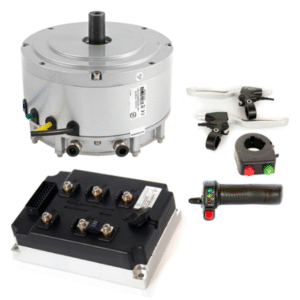
Component mismatches can limit performance or even cause failure. Motors and controllers must share compatible voltage and current ratings and be configured as a complete system rather than selected independently. One effective way to avoid these issues is to work with suppliers that provide integrated drive solutions. Brushless Inc., for example, offers pre-calibrated motor-controller pairs for its high-torque BLDC platforms and publishes open communication protocols, reducing tuning effort and helping ensure the final system performs as intended.
Misunderstanding peak and continuous torque leads to unrealistic expectations. Peak torque values only apply for short bursts, while continuous torque determines real-world performance during sustained riding.
System weight is a perennial challenge, especially as the industry pushes for higher power density. Every extra kilogram in the motor or battery impacts handling and range, making weight efficiency a critical design priority for off-road and performance builds.
Conclusion
Selecting the ideal high-torque BLDC motor for an electric motorcycle means aligning torque, speed, load, and power requirements with the motor’s electrical and mechanical capabilities. A structured approach—defining load profiles, selecting the right voltage system, understanding torque-speed behavior, and ensuring controller compatibility—helps builders achieve the desired balance of performance and durability.
By combining real-world riding needs with proven engineering practices, developers can confidently select a motor that delivers the torque and reliability required for a successful electric motorcycle project.